
Widening of the existing NH4 in lieu of a new expressway

|
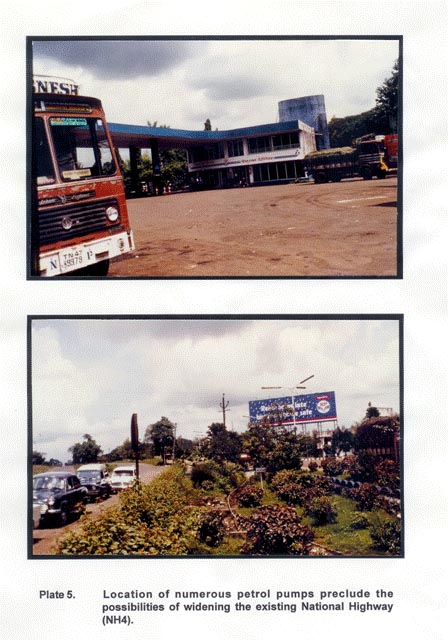
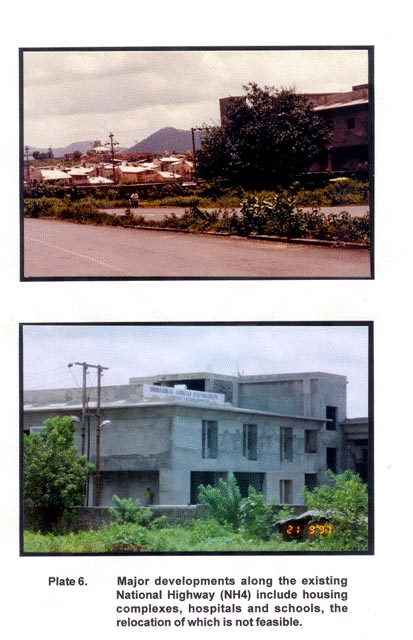
Widening of the existing NH-4 all the way from Panvel to Dehu Road has emerged out to be the strongest option to arrest the impacts of expressway development. As per the Regional Plan for Pune district, the existing NH-4 would be widened to 60 m. The plan suggests that 8 lane divided carriageway can be provided within 60 m with a 5 m wide median, one meter wide hard shoulder and an extra meter soft shoulder for pedestrians and cyclists. Presently, this highway NH-4 is a two lane undivided highway for 4 km after Panvel. Thereafter it is a 4 lane divided highway for 10 km and a two lane undivided highway up to Khopoli, which is one of the bottlenecks on the way to Pune. The Ghat section is a 2 lane divided highway with small stretches in which the lanes remain undivided. The possibility of a bypass near Khopoli may reduce the Pune bound traffic on NH-4. The traffic projections clearly indicate that even in the absence of proposed expressway, the trends of traffic on existing highway will require 10 lanes by 2005. The year 2012 will see one lakh seventy eight thousand vehicles move the NH-4 corridor (Traffic Survey Report of RITES, 1995). This will beyond doubt be the saturation point for traffic on this road and if the number of value added industries continue to be encouraged for combating the declining availability of natural resource base then this saturation point would be reached even much earlier then the projected year. The existing highway, even if widened, will not be the best route for the movement of increasing container traffic because of the unsuitable gradient in the Ghat section. Widthwise expansion of existing highway is practically impossible because of the mushrooming growth of industrial establishments and civic amenities along the entire length of existing NH-4. In most situations, these developments have spread in the area which are contiguous with the areas that can be designated as soft shoulders of the highway. Of the most conspicuous developments along the road in the non-Ghat section are the petrol pumps (nearly one after every 500 m), Lodhivali Township, Reliance Industries, Ambani School, a Mosque, Govt. Dairy Project, the Township of Khopoli and the Complex of Indian Organic Chemicals Ltd. (Plate 5 & 6).
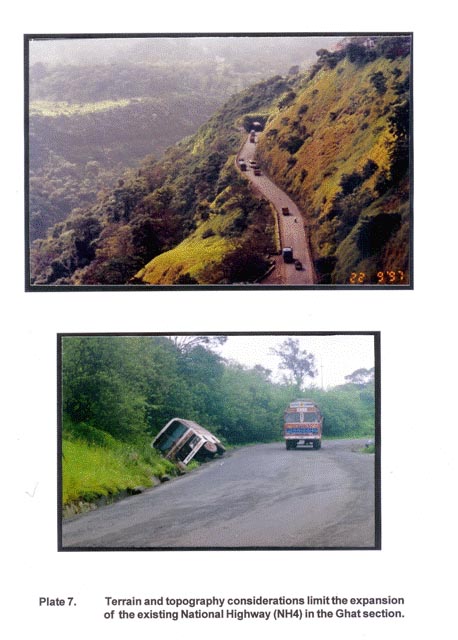
The Ghat section stretch has constraints of gradient and width which cannot be overcome given the physiographic realities of the area - a valley on one side and a high hill on the other side. Even with the remotest possibility of a widened NH-4 in the non Ghat section, the Ghat would continue to pose a `bottleneck’ and remain accident prone. This will continue to pose the problems of traffic congestion (Plate 7).
Our discussions with different stakeholders and our observations during the reconnaissance along the existing NH-4 make it amply evident that the option of widening of existing NH-4 in the entire stretch is thus neither possible nor a viable option to arrest the development of Mumbai - Pune Expressway on several counts. Acquisition of the developed land in the non Ghat section at a higher price would also lead to distorted costs and benefits of the expressway project. New or upgraded roads are also known to result in increased land values and more intensive land use especially in land adjacent to the road. The result is often a shift in land ownership or rights of resource use from poorer to wealthier classes. This may have the effect of pushing the original tenants back from the roadsides into the undeveloped areas such as valley slopes or marginal lands. |
Last Updated: October 9, 2015